Narrative
Table of Contents
Introduction
Museums are often presented as neutral spaces that preserve art history, but when we look closely at the data behind their collections it becomes clear that they also make decisions about visibility and value. In this project, our team analyzes the Museum of Modern Art’s Open Access Collection dataset to examine how nationality, gender, and acquisition timing shape who becomes visible in MoMA’s archive. Our visualizations show a heavy concentration of American and Western European artists, with more than 5,300 American artists represented while many regions across Africa, Latin America, and parts of Asia appear far less frequently. When we examined acquisition trends over time, we also saw that works by female artists made up a very small percentage of acquisitions for most of the twentieth century and only increased more noticeably in recent decades. By comparing the “Date” an artwork was created with the “Date Acquired,” we argue that MoMA’s metadata does not simply record art history. It plays an active role in shaping it by influencing when artists receive institutional recognition. Our analysis builds on the scholarly frameworks outlined in our annotated bibliography and uses MoMA’s publicly available dataset to examine how museums function as institutions of cultural power in shaping who gets seen.
Scholars in museum and cultural studies increasingly challenge the idea that museums operate as neutral institutions. Writers such as Möntmann and Tucker argue that modern art museums have historically shaped and reinforced a Western canon rather than simply documenting artistic production. Much of this scholarship focuses on curatorial decisions, exhibition practices, and institutional narratives that privilege certain regions, artists, and artistic movements. However, fewer studies examine how these power structures appear within museum datasets and metadata systems themselves. This gap raises important questions about how digital archives and collection databases may reproduce the same patterns of cultural authority that scholars have identified in museum exhibitions.
We study MoMA’s artist database to better understand how institutional data shapes cultural visibility over time. By analyzing nationality patterns, gender representation, and acquisition lag together, we show that power operates not only through who is included but also through when recognition happens and how artists are categorized. Museums influence how modern art is taught, remembered, and valued. When certain nationalities dominate collections and female artists are historically acquired later or in smaller numbers, those patterns become part of the official story of modern art. Our project helps reveal how institutional databases contribute to constructing that narrative. While museums often feel like places where we revisit the past, that past has been actively curated. It reflects decisions made by specific people within institutions, and those decisions shape what viewers understand as important or legitimate.
Literature Review
OVERVIEW
Recent scholarship in museum studies and digital humanities challenges the idea that museums function as neutral repositories of cultural history. Instead, researchers argue that museums actively shape artistic narratives through collecting decisions, classification systems, and digital documentation. These institutional processes influence which artists gain recognition and which remain less visible. Studies of museum exhibitions and collections show that displays and institutional narratives often reflect broader social assumptions rather than objective historical representation (Piqueras et al. 2022).
Several studies have shown that representation within museum collections reflects broader social hierarchies. Research examining major museum collections in the United States found that artists represented in these institutions are overwhelmingly white and male, demonstrating clear inequalities in institutional representation (Topaz et al. 2019). These demographic patterns suggest that museum collections can reinforce existing cultural power structures rather than simply documenting artistic production.
Other scholars focus on the role of nationality in shaping artistic visibility. Alain Quemin argues that artistic recognition in the global art world remains concentrated among a small number of Western countries, particularly the United States, Germany, and the United Kingdom (Quemin 2015). These countries dominate international rankings, galleries, and institutional collections, which suggests that artistic prestige is strongly connected to geopolitical power rather than purely artistic merit.
Scholars have also examined how museums contribute to shaping artistic canons. Marcia Tucker argues that dominant narratives of modern art have historically been constructed through institutional decisions that privilege particular artistic movements, geographies, and artists while excluding others (Tucker 2014). Nina Möntmann similarly argues that contemporary art institutions remain influenced by colonial legacies and Eurocentric frameworks that continue to shape representation within museum collections (Möntmann 2023).
Another area of research focuses on digital museum databases and metadata systems. Scholars examining online museum collections argue that metadata fields such as nationality, gender, and classification categories can encode cultural bias and influence how artists are represented and discovered within digital archives (Zhitomirsky-Geffet, Kizhner, and Minster 2023). Other research on museum digitization shows that digital cataloging and documentation processes involve selective decisions about what information is recorded and made visible, meaning that digitization does not automatically produce neutral or complete records (Navarrete and Baumol 2010).
Finally, some scholars examine museum acquisition patterns. Research on museum collections introduces the concept of collection lag, which refers to the time between when an artwork is created and when it is acquired by a museum. Quantitative studies show that many institutions acquire works years or even decades after they are produced, revealing systematic patterns in how museums recognize and legitimize artists over time (Canet Sola et al. 2023).
Together, these studies provide a framework for understanding how museum datasets reflect broader systems of cultural power, institutional decision making, and historical canon formation.
DISCREPANCIES
Although scholars generally agree that museum collections reflect cultural hierarchies, there are different interpretations of why these patterns exist.
Some researchers argue that representation disparities reflect historical realities within the art world. Artists from Western countries historically had greater access to galleries, collectors, and institutional networks, which increased their chances of gaining international recognition.
Other scholars argue that museums themselves play a more active role in reinforcing these inequalities. Institutional collecting practices and classification systems may continue to privilege artists who already hold positions of cultural prestige.
There are also debates about the impact of digitization. Digital archives are often described as tools that democratize access to museum collections. However, some scholars argue that digitization can reinforce institutional authority because decisions about metadata creation and documentation determine which artworks become most visible within digital systems.
These perspectives highlight the importance of analyzing museum datasets critically rather than assuming they provide neutral representations of cultural history.
COMMONALITIES
Despite these differences, several themes appear consistently across the literature.
First, museums play an important role in shaping artistic canons rather than simply preserving them. Institutional decisions about collecting and documentation influence which artists become historically recognized.
Second, metadata and digital classification systems influence visibility within museum databases. The way artists are categorized and documented affects how easily they can be discovered and analyzed.
Third, museum acquisition practices shape artistic legitimacy. When museums acquire artworks after artists have already gained recognition, those acquisitions reinforce existing hierarchies while also contributing to how art history is written.
These shared ideas provide the foundation for our analysis of MoMA’s dataset.
Significance
This project contributes to ongoing discussions in digital humanities and museum studies about how cultural institutions shape historical narratives.
By analyzing the Museum of Modern Art’s Open Access Collection dataset, we examine how patterns of representation appear within the data that organizes museum collections. Rather than focusing only on exhibitions or curatorial decisions, our project highlights how representation patterns are embedded within the datasets themselves.
Our visualizations reveal patterns in artist nationality, gender representation, and acquisition timing. These patterns show how institutional decisions influence which artists gain visibility and recognition.
Examining acquisition lag also provides insight into how museums construct artistic legitimacy over time. When there are long delays between the creation of an artwork and its acquisition, this suggests that institutional recognition often follows broader validation within the art world.
Understanding these patterns helps us see museum databases as more than technical tools. They function as systems that organize cultural memory and influence how art history is interpreted by researchers, educators, and the public.
Ultimately, this project encourages viewers to think critically about how museums construct the narratives they present.
Data Visualizations
Data Visualization #1
This Voyant word map visualizes the nationalities of artists represented in MoMA’s archive, with each nationality appearing as a word whose size corresponds to how frequently it appears in the dataset. The large prominence of American artists indicates that they make up the largest share of the archive, while other nationalities such as French, British, German, and Italian also appear prominently but at smaller scales. Although artists from other regions are present, they appear much smaller in the visualization, indicating comparatively lower representation. Overall, the word map shows that the most visible nationalities in MoMA’s archive are largely from the United States and Western Europe, highlighting how the collection is concentrated among Western countries while many other regions appear only marginally.
Data Visualization #2
This map visualizes the global distribution of artists represented in MoMA’s collection by nationality. Countries shaded in darker blue indicate a higher number of artists included in the dataset, while lighter shades represent fewer artists. The map immediately reveals a strong concentration of artists from the United States and Western Europe, particularly the United States, France, Germany, and the United Kingdom. In contrast, much of Africa, the Middle East, and parts of Southeast Asia show little or no representation. This uneven geographic pattern suggests that MoMA’s collection reflects historical centers of artistic recognition rather than a balanced representation of global artistic production. Because major museums play a significant role in shaping the modern art canon, these collecting patterns help determine which artists gain international visibility. The visualization therefore highlights how nationality within the database reflects broader structures of cultural power and institutional influence.
Data Visualization #3
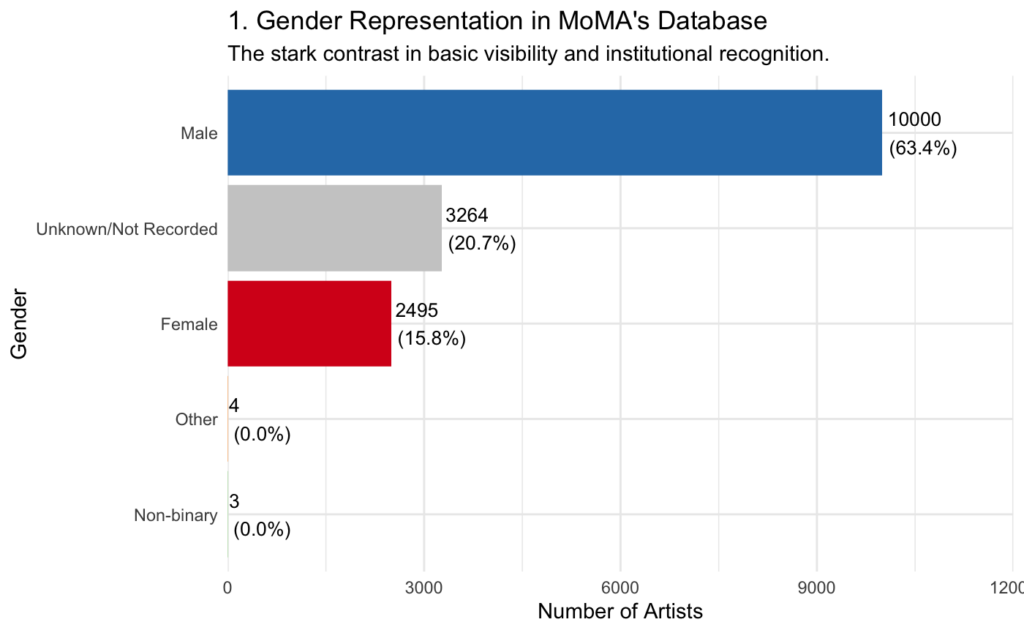
This bar chart presents the overall gender distribution of artists recorded in the MoMA dataset. Male artists make up the majority of the database, accounting for more than sixty percent of the recorded artists. Female artists represent a significantly smaller portion of the dataset, while a notable number of entries are categorized as “Unknown / Not Recorded.” This imbalance reflects historical patterns in which male artists received greater recognition, exhibition opportunities, and institutional support within the art world. At the same time, the large share of missing gender data highlights the role of metadata completeness in shaping visibility within digital archives. When demographic information is absent, certain identities may remain obscured or difficult to analyze. The visualization therefore reveals both structural gender inequality and the limitations of the dataset itself, illustrating how databases can simultaneously reflect and reinforce institutional histories of recognition.
Data Visualization #4
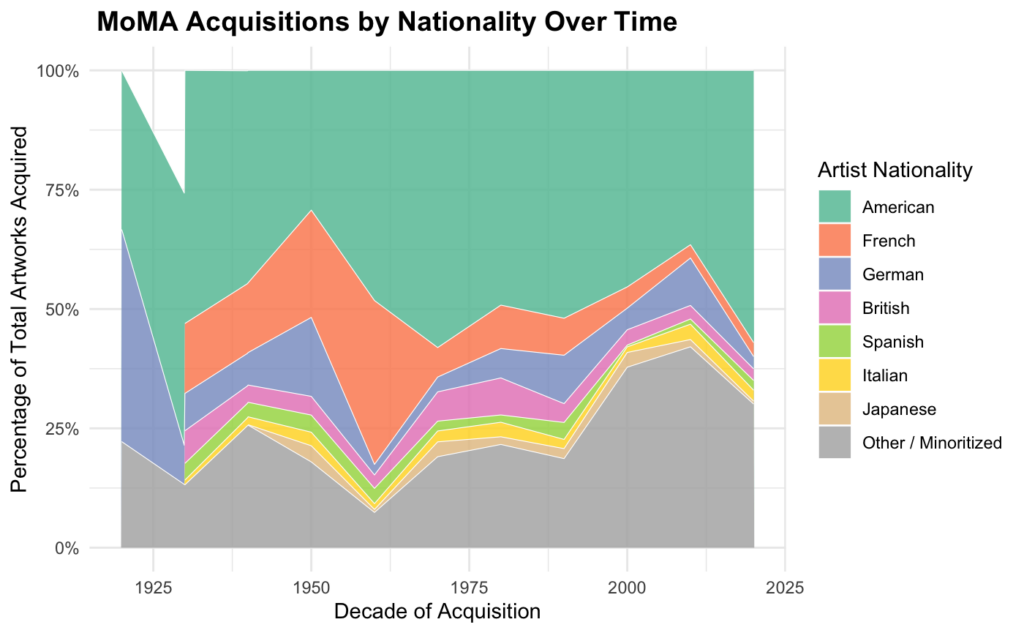
This stacked area chart illustrates how the nationalities of artists represented in MoMA acquisitions have changed across decades. American artists consistently occupy the largest share of acquisitions, particularly after the mid-twentieth century, reflecting the growing influence of the United States within the global art world. European nationalities such as French, German, and British artists also maintain a strong presence throughout the timeline. In contrast, artists grouped under “Other / Minoritized” appear in much smaller proportions, especially in earlier decades. Although the chart suggests a gradual increase in diversity in recent years, Western artists still dominate the overall composition of the collection. This pattern reflects how museums historically centered certain geographic regions when defining modern art. By visualizing acquisitions across time, the chart demonstrates how institutional collecting practices shape which cultural traditions become visible within the museum canon.
Data Visualization #5
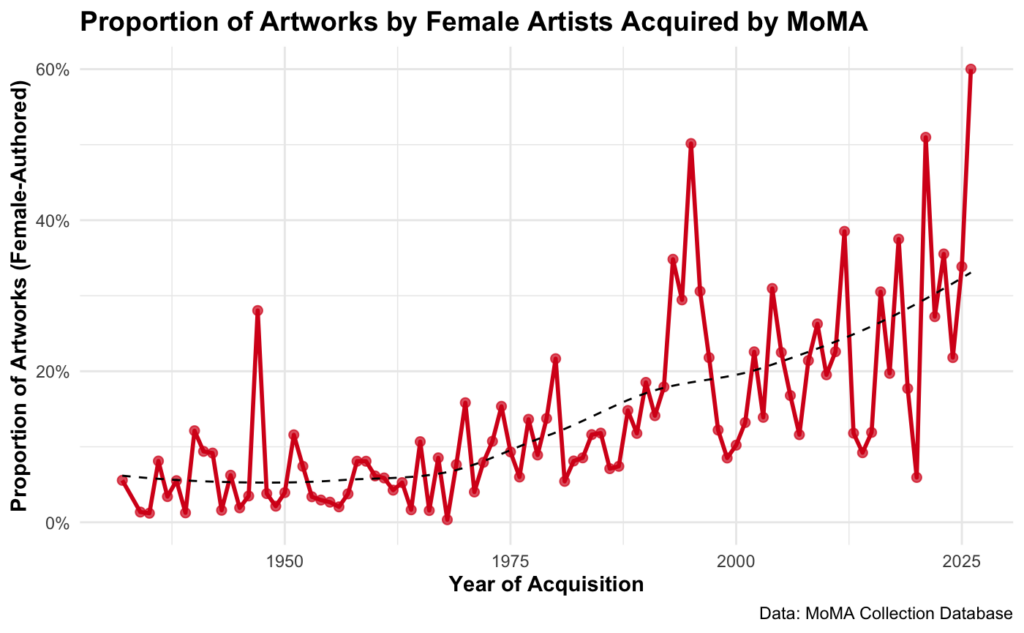
This line chart tracks the proportion of artworks by female artists acquired by MoMA over time. In the early decades of the museum’s history, female-authored works represent only a very small share of acquisitions, often remaining below ten percent. This pattern reflects the long-standing gender imbalance within the art world, where women artists historically received less institutional recognition. Beginning in the late twentieth century, however, the chart shows a gradual upward trend. The increasing proportion of female artists suggests that museums have begun responding to critiques from feminist art historians and broader calls for representation. Despite this progress, the data also shows that women artists remain significantly underrepresented compared to their male counterparts. The visualization therefore illustrates both the persistence of historical inequality and the gradual institutional shifts that have begun to reshape museum collecting practices.
Data Visualization #6
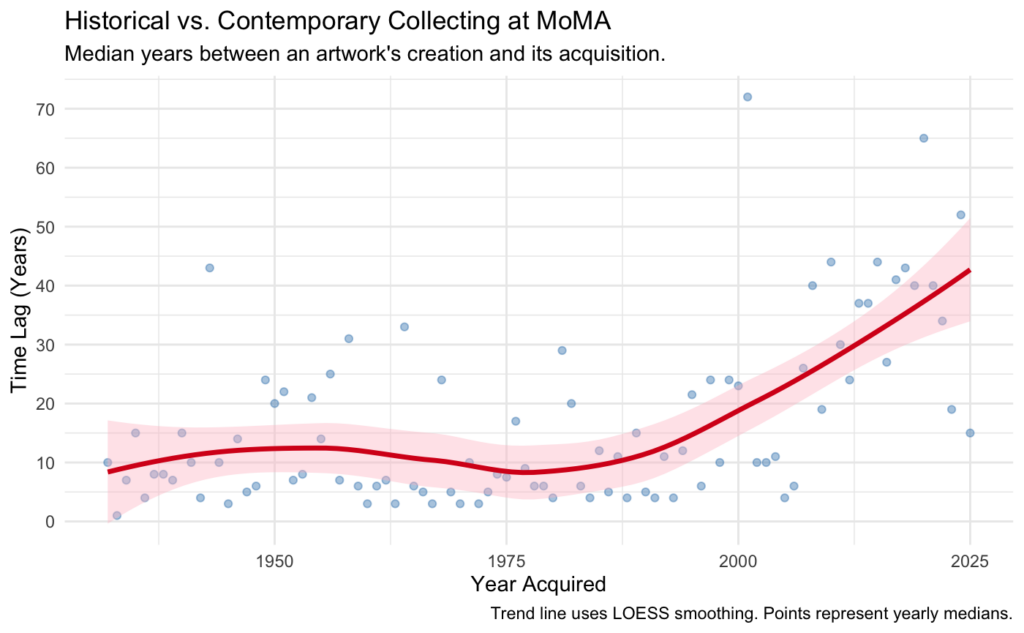
This scatterplot examines the time lag between when an artwork was created and when it was acquired by MoMA, comparing the variables “Date” and “Date Acquired.” Each point represents the median number of years between creation and acquisition for a given year. In the early decades of the museum’s history, the time lag tends to remain relatively short, suggesting that MoMA often collected artworks not long after they were produced. However, the trend line shows a noticeable increase in acquisition lag in more recent decades. This pattern indicates that the museum increasingly collects artworks long after their original creation, sometimes decades later. Such shifts may reflect changes in curatorial priorities, historical reevaluation of artists, or efforts to incorporate previously overlooked works into the collection. The visualization therefore highlights how institutional recognition can evolve over time, revealing the delayed processes through which artworks enter the museum canon.
Conclusion
Returning to our research questions, our analysis shows that MoMA’s dataset reflects patterns of cultural power through both representation and acquisition timing.
First, the dataset reveals clear inequalities in nationality and gender representation. Artists from the United States and Western Europe dominate the collection while artists from many other regions appear far less frequently. Male artists also make up the majority of represented artists, particularly in earlier decades.
Second, our analysis of acquisition timing shows that museums often acquire artworks many years after they are created. This delay suggests that institutional recognition frequently follows broader validation within the art world.
Together, these patterns demonstrate that museum datasets do more than record artistic production. They help shape the narrative of modern art by determining which artists become visible and when they receive institutional recognition.
By analyzing MoMA’s dataset through visualizations and quantitative methods, this project highlights how cultural authority operates within museum databases and encourages viewers to question how institutions construct the histories they present.